
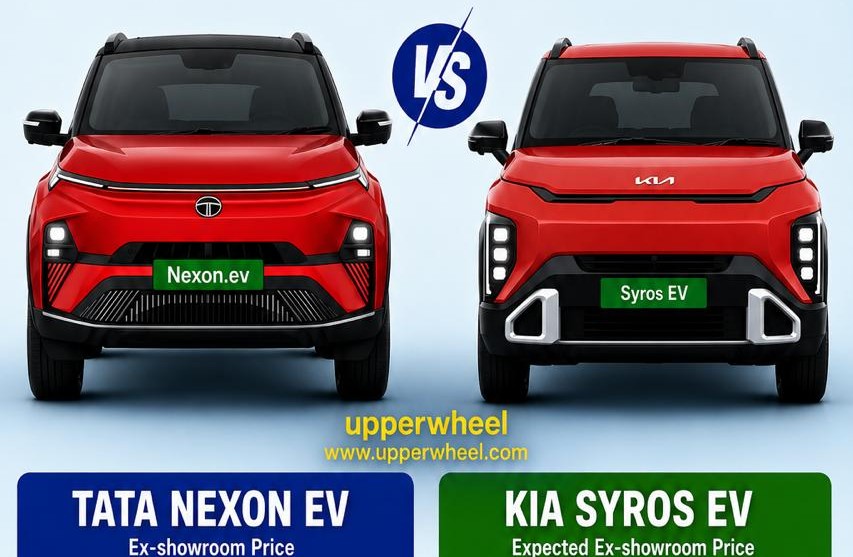
Tata has dominated the EV segment for years with the Nexon EV, but Kia has entered the game with the all-new Syros EV, offering bigger batteries, more power, and premium features at competitive pricing. So today we will try to find Tata Nexon EV VS Kia Syros EV Which Is Better in this article. Like if you’re planning to spend around ₹14 lakh to ₹19 lakh, which EV deserves your money?
In this detailed comparison, we’ll compare the Tata Nexon EV and Kia Syros EV based on price, variants, battery, range, charging, performance, and overall value for money. By the end, you’ll know exactly which EV suits your needs.
Tata Nexon EV vs Kia Syros EV: Quick Verdict
Buy the Tata Nexon EV if you:
- Want a proven and reliable electric SUV
- Drive mostly within the city
- Prefer Tata’s extensive EV service network
- Want lower entry pricing
Buy the Kia Syros EV if you:
- Want maximum driving range
- Need faster DC charging
- Prefer higher performance
- Want more premium features and a fresh design
For buyers looking at the long term, the Kia Syros EV offers more value for money, especially in the higher variants.
Tata Nexon EV vs Kia Syros EV Price Comparison
One of the biggest deciding factors is pricing.
| Kia Syros EV Variant | Battery | Expected Price |
|---|---|---|
| HTK | 42 kWh | ₹13.99 lakh |
| HTK+ | 42 kWh | ₹14.69 lakh |
| HTX | 42 kWh | ₹15.49 lakh |
| HTK+ ER | 51.4 kWh | ₹16.49 lakh |
| HTX ER | 51.4 kWh | ₹17.49 lakh |
| HTX+ ER | 51.4 kWh | ₹18.49 lakh |
| X-Line ER | 51.4 kWh | ₹18.99 lakh |
Tata Nexon EV Prices
| Tata Nexon EV Variant | Battery | Ex-showroom Price |
|---|---|---|
| Creative | 45 kWh | ₹14.14 lakh |
| Fearless | 45 kWh | ₹15.14 lakh |
| Empowered | 45 kWh | ₹16.14 lakh |
| Empowered +A | 45 kWh | ₹17.49 lakh |
Price Analysis
The Tata Nexon EV starts at a slightly higher price of ₹14.14 lakh, while the Kia Syros EV starts from ₹13.99 lakh.
However, the biggest advantage of the Syros EV is its wider variant lineup. Buyers can choose between standard-range and extended-range models, making it easier to match different budgets and driving needs.
Winner: Kia Syros EV
Variant-Wise Comparison
Let’s compare similar price points to understand which one offers better value.
| Kia Syros EV | Tata Nexon EV | Which Offers Better Value? |
|---|---|---|
| HTK | Creative | Syros offers a lower starting price. |
| HTK+ | Fearless | Depends on preferred features, but pricing remains competitive. |
| HTX | Empowered | Syros gains with stronger performance. |
| HTX ER | Empowered +A | Syros offers a larger battery and longer claimed range. |
Kia gives buyers more flexibility by offering both 42 kWh and 51.4 kWh battery options, whereas the Nexon EV lineup shown here is centered around the 45 kWh battery.
Battery Pack and Driving Range
Battery size directly impacts how far an EV can travel before needing a recharge.
| Specification | Kia Syros EV | Tata Nexon EV |
|---|---|---|
| Battery Options | 42 kWh / 51.4 kWh | 30 kWh / 45 kWh* |
| Maximum Claimed Range | 526 km | Up to 489 km |
| Fast Charging | 100 kW DC | 60 kW DC |
| 10-80% Charging Time | 39 minutes | 40 minutes |
*The comparison image focuses on the 45 kWh Nexon EV variant.
What Does This Mean in Real Life?
If your daily commute is around 40–60 km, both EVs will comfortably meet your needs.
However, for buyers who frequently travel on highways or take weekend road trips, the Syros EV’s larger battery and higher claimed range can reduce charging stops and provide more peace of mind.
Another advantage is the 100 kW DC fast charging support, which gives the Syros EV an edge when compatible high-speed chargers are available.
Winner: Kia Syros EV
Performance Comparison
Performance matters because an electric vehicle should feel quick, smooth, and effortless to drive.
| Specification | Kia Syros EV | Tata Nexon EV |
|---|---|---|
| Power | 168 bhp | 142 bhp (Approx.) |
| Torque | 255 Nm | 215 Nm |
| 0–100 km/h | 8.1 seconds | 8.9 seconds |
Driving Experience
The Kia Syros EV produces more power and torque, resulting in stronger acceleration and better overtaking performance.
The Tata Nexon EV, meanwhile, continues to deliver a smooth and confidence-inspiring drive that many Indian buyers already appreciate.
If spirited performance is high on your priority list, the Syros EV has the advantage.
Winner: Kia Syros EV
Features and Everyday Practicality
While both SUVs are expected to offer modern technology, the buying experience differs.
Kia Syros EV
Pros
- Larger battery choices
- Longer claimed driving range
- Faster DC charging capability
- More powerful electric motor
- Multiple variants for different budgets
- Fresh and premium-looking design
Tata Nexon EV
Pros
- Established EV ecosystem
- Proven reliability in the Indian market
- Mature charging and ownership experience
- Comfortable ride quality
- Strong resale confidence
Which EV Gives Better Value for Money?
Price alone doesn’t define value. You should also consider battery capacity, performance, charging speed, and long-term usability.
Choose the Kia Syros EV if:
- You frequently drive long distances.
- You want the biggest battery available.
- Faster charging is important.
- You enjoy quick acceleration.
- You want a feature-rich, modern EV with multiple variant options.
Choose the Tata Nexon EV if:
- You trust Tata’s established EV ecosystem.
- Your driving is mostly within city limits.
- You prefer a model with an established ownership record.
- You value service network familiarity and proven reliability.
Expert Opinion
If both vehicles are available at similar prices, the Kia Syros EV appears to offer stronger value on paper. The combination of a larger 51.4 kWh battery, up to 526 km claimed range, 100 kW DC fast charging, and higher power output makes it a compelling option for buyers who want the latest technology.
However, buying a car is about more than specifications. The Tata Nexon EV remains an excellent choice for those who prioritize a well-established ownership experience, widespread familiarity in the Indian EV market, and confidence that comes from a model with a proven track record.
In short:
- Best for highway travelers and performance enthusiasts: Kia Syros EV
- Best for dependable daily commuting and established ownership support: Tata Nexon EV
Also Read: Tata Nexon EV vs MG Windsor EV Which Is Better
Final Verdict
The competition between the Tata Nexon EV and Kia Syros EV is closer than it first appears.
The Nexon EV continues to be a dependable, well-rounded electric SUV with a strong reputation. But if your priority is maximizing range, performance, and charging capability for the money, the Kia Syros EV has a clear edge based on the specifications compared here.
If your budget is between ₹16 lakh and ₹19 lakh, the extended-range Kia Syros EV variants stand out as particularly attractive choices for buyers planning to keep their EV for several years.
FAQs
1. Which EV has a longer driving range, Tata Nexon EV or Kia Syros EV?
The Kia Syros EV offers a claimed range of up to 526 km, while the Tata Nexon EV offers up to 489 km in the compared variant.
2. Which electric SUV charges faster?
The Kia Syros EV supports 100 kW DC fast charging, whereas the Tata Nexon EV supports 60 kW DC fast charging. Both claim a similar 10–80% charging time under ideal conditions, but the Syros EV is better equipped for higher-capacity chargers.
3. Which EV is more powerful?
The Kia Syros EV produces 168 bhp and 255 Nm, compared to approximately 142 bhp and 215 Nm for the Tata Nexon EV, making the Kia the more powerful option.
4. Which EV is better for city driving?
Both are suitable for city use. The Tata Nexon EV benefits from an established ownership ecosystem, while the Kia Syros EV offers greater flexibility if you also plan occasional highway trips.
5. Which EV offers better value for money?
If your priorities are battery size, range, charging speed, and performance, the Kia Syros EV offers stronger value on paper. If you prioritize a proven ownership experience and a well-established EV ecosystem, the Tata Nexon EV remains a solid choice.
Related Posts:
- Mahindra BE6 Sporteq VS Vinfast VF6 Comparison And Price

- Honda ZRV VS Skoda Kodiaq Comparison And Price :…

- MG Hector Tomahawk EV vs Mahindra XEV 9S Comparison…

- Kia Syros EV vs Maruti e Vitara Comparison and…

- MG Hector Tomahawk EV Specifications And Price In India

- Brezza Facelift Turbo VS Kia Syros Comparison And…

1 thought on “Tata Nexon EV VS Kia Syros EV Which Is Better”
Comments are closed.