
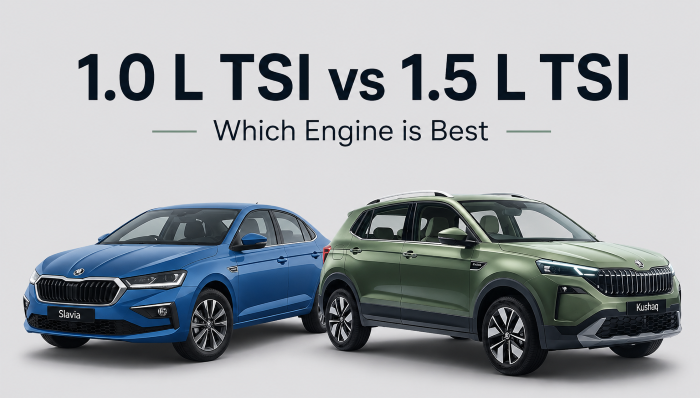
If you’re planning to buy a Volkswagen Virtus, Skoda Slavia, Skoda Kushaq, or Skoda Kylaq, one question will almost certainly come to mind: Which engine is better 1.0 TSI or 1.5 TSI? Turbocharged petrol engines have transformed the driving experience in India over the last few years. Volkswagen and Skoda, in particular, have earned a strong reputation for offering refined and performance-oriented TSI engines. If you’re planning to buy a Volkswagen Virtus, Skoda Slavia, Kushaq, or Kylaq, this question is almost unavoidable.
At first glance, both engines look similar. Both use turbocharging, both are petrol-powered, and both deliver smooth highway performance. However, their engine architecture, driving character, long-term ownership experience, and intended audience are quite different.
This article gives good analysis into the engineering, performance, reliability, and real-world usability of both engines to help you make the right choice.
Quick Comparison
| Specification | 1.0 TSI | 1.5 TSI |
|---|---|---|
| Engine Capacity | 999 cc | 1498 cc |
| Cylinders | 3 | 4 |
| Turbocharger | Yes | Yes |
| Maximum Power | 115 PS | 150 PS |
| Peak Torque | 178 Nm | 250 Nm |
| Manual Gearbox | 6-Speed | No (India in most models) |
| Automatic | 8-Speed Torque Converter | 7-Speed DSG |
| Fuel Efficiency | Higher | Slightly Lower |
| Performance | Good | Excellent |
| Best For | City & occasional highways | Highway enthusiasts & spirited drivers |
Engine Design: Bigger Difference Than Just Engine Size
Many buyers assume the only difference is displacement. In reality, the engineering philosophy behind these engines is very different.
1.0 TSI: Built for Efficiency
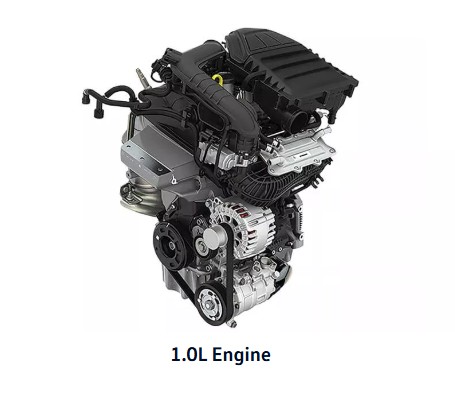
The 1.0 TSI is a three-cylinder turbocharged petrol engine designed to extract maximum efficiency from a smaller capacity.
Its compact design offers several advantages:
- Lower engine weight
- Better fuel economy
- Lower emissions
- Quicker warm-up
- Lower manufacturing cost
The turbocharger compensates for the smaller displacement by delivering strong torque from low RPMs, making the engine feel more powerful than its size suggests.
However, because it’s a three-cylinder engine, a small amount of vibration at idle is natural compared to a four-cylinder unit.
1.5 TSI: Engineered for Performance
The 1.5 TSI belongs to Volkswagen Group’s newer generation of premium turbo petrol engines.
Unlike the 1.0 TSI, this is a four-cylinder engine.
Advantages include:
- Better engine balance
- Smoother refinement
- Higher power output
- Stronger high-speed cruising
- Less vibration
One of its biggest engineering highlights is Active Cylinder Technology (ACT).
During light cruising, the engine automatically shuts down two cylinders to save fuel. When more power is needed, all four cylinders reactivate almost instantly.
This means buyers get strong performance without a major compromise in efficiency.
Performance Comparison
This is where the biggest difference appears.
1.0 TSI Driving Experience
Despite having only one litre of displacement, the turbocharger makes the engine surprisingly lively.
In city traffic:
- Quick acceleration
- Smooth overtaking
- Excellent low-end torque
- Easy to drive
On highways:
The engine comfortably cruises at 100–120 km/h.
However, when fully loaded with passengers and luggage, frequent overtakes require more planning compared to the 1.5 TSI.
1.5 TSI Driving Experience
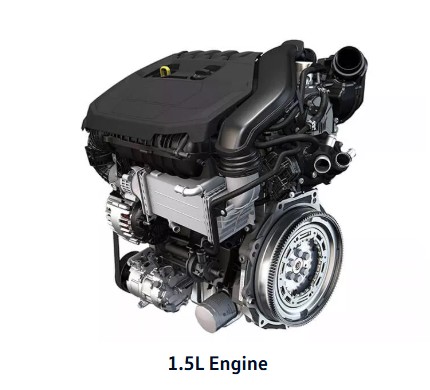
The 1.5 TSI feels like an entirely different category.
Power delivery is stronger throughout the rev range.
The larger engine produces significantly more torque, making overtaking effortless.
Whether you’re climbing steep hills, carrying five passengers, or driving on expressways, the engine always feels relaxed.
Enthusiastic drivers will especially appreciate the stronger mid-range and quicker acceleration.
Transmission Comparison
The transmission paired with each engine also influences the driving experience.
1.0 TSI
Available with:
- 6-Speed Manual
- 8-Speed Torque Converter Automatic
The torque converter automatic is known for:
- Smooth gear shifts
- Excellent city comfort
- Proven long-term reliability
- Better suited to stop-and-go traffic
For buyers prioritizing hassle-free commuting, this is an excellent choice.
1.5 TSI
Available with:
- 7-Speed DSG Dual-Clutch Automatic
The DSG gearbox delivers:
- Lightning-fast gear shifts
- Better acceleration
- Sportier driving feel
- Improved highway performance
The trade-off is that dual-clutch gearboxes are mechanically more complex than conventional torque converters. Modern DSG units have improved significantly, but long-term maintenance costs can be higher than a traditional automatic if major repairs are ever required.
Fuel Efficiency
Many buyers assume the 1.0 TSI is dramatically more fuel efficient.
In reality, the gap isn’t as large as expected.
City
1.0 TSI generally returns better mileage because of:
- Smaller displacement
- Lower weight
- Less fuel consumption in traffic
Highway
The 1.5 TSI’s Active Cylinder Technology helps narrow the difference during steady cruising, as the engine can deactivate two cylinders under light loads.
Real-world mileage will still depend heavily on driving style, traffic, terrain, and vehicle load.
Reliability: Which Engine Is More Dependable?
Reliability is one of the biggest concerns for Indian buyers.
1.0 TSI Reliability
The 1.0 TSI has earned a reputation as a dependable modern turbo-petrol engine when maintained according to the manufacturer’s service schedule.
Its simpler automatic option (torque converter) is another advantage for buyers who prioritize peace of mind.
Like most direct-injection turbo engines, it benefits from:
- Timely engine oil changes using the recommended grade
- Good-quality fuel
- Avoiding aggressive driving before the engine reaches operating temperature
1.5 TSI Reliability
The 1.5 TSI is also considered a well-engineered and reliable engine, with strong refinement and robust performance.
The engine itself has generally shown good durability in global and Indian markets. The main consideration for long-term ownership is the paired DSG transmission, which is more sophisticated than a conventional automatic. With proper servicing and sensible driving habits, modern DSG gearboxes perform very well, but potential repair costs can be higher if significant issues arise after the warranty period.
Overall, neither engine has a clear reliability advantage when properly maintained. Your ownership experience will depend more on regular servicing, driving habits, and following the manufacturer’s maintenance schedule than on the engine choice alone.
Maintenance Cost
Routine servicing costs are broadly similar, though the 1.5 TSI may cost slightly more over time because of its larger engine and DSG transmission.
If keeping ownership costs as low as possible is your priority, the 1.0 TSI generally has the edge.
Which Engine Feels More Premium?
If refinement is important, the answer is straightforward.
The four-cylinder 1.5 TSI feels:
- Quieter
- Smoother
- More effortless
- Better at high speeds
The 1.0 TSI remains refined for its class, but a three-cylinder engine naturally has a different character, especially at idle.
Who Should Buy the 1.0 TSI?
Choose the 1.0 TSI if you:
- Mostly drive in cities
- Travel 10,000–15,000 km per year
- Want better fuel economy
- Prefer lower purchase cost
- Want a smooth automatic with a torque converter
- Occasionally take highway trips
For the majority of Indian families, the 1.0 TSI offers an excellent balance of performance, efficiency, and value.
Who Should Buy the 1.5 TSI?
Choose the 1.5 TSI if you:
- Frequently drive on highways
- Love enthusiastic driving
- Want effortless overtaking
- Often travel with a full load of passengers
- Value refinement and stronger performance
- Plan to keep the car for long-distance touring
If driving enjoyment is high on your priority list, the 1.5 TSI is the more rewarding engine.
Also Read : Skoda Kushaq vs Hyundai Creta N Line Comparison And Price
Expert Verdict
There isn’t a universal winner because these engines are built for different buyers.
The 1.0 TSI is the practical all-rounder. It delivers impressive performance for its size, good efficiency, and lower ownership costs, making it the smarter choice for most urban users.
The 1.5 TSI, however, stands out for buyers who want a more premium driving experience. Its extra power, smoother four-cylinder refinement, stronger highway performance, and advanced engineering make it the enthusiast’s choice.
If your budget allows and your driving includes frequent highway journeys, the 1.5 TSI is worth the premium. If your usage is mainly city commuting with occasional trips, the 1.0 TSI provides outstanding value without feeling underpowered.
FAQs
Is the 1.5 TSI faster than the 1.0 TSI?
Yes. With around 150 PS and 250 Nm, the 1.5 TSI offers noticeably stronger acceleration and more confident overtaking than the 115 PS, 178 Nm 1.0 TSI.
Is the 1.0 TSI enough for highway driving?
Yes. It can comfortably cruise at highway speeds and handle overtaking, though it won’t feel as effortless as the 1.5 TSI, especially with a full load.
Which engine is better for city driving?
The 1.0 TSI is generally the better choice for city use thanks to its lower purchase price, good fuel efficiency, and the availability of a smooth 8-speed torque converter automatic.
Does the 1.5 TSI offer better fuel efficiency on highways?
It can be surprisingly efficient on long highway drives because of its Active Cylinder Technology, which deactivates two cylinders under light engine loads. Actual mileage will vary depending on driving conditions and style.
Which engine is more refined?
The 1.5 TSI’s four-cylinder layout makes it smoother and quieter than the three-cylinder 1.0 TSI, particularly at idle and during hard acceleration.
Which engine is better for long-term ownership?
Both engines are capable of long-term reliability when serviced on schedule. Buyers choosing the 1.5 TSI should be aware that its DSG automatic is a more complex transmission than the 1.0 TSI’s torque converter automatic, which may influence long-term maintenance considerations.
Related Posts:
- Skoda Slavia Facelift vs Honda City Comparison and…
- Skoda Slavia Facelift VS Hyundai Verna Comparison…
- Skoda Slavia Facelift 2026 Colours : Complete Colour…
- Honda ZRV VS Skoda Kodiaq Comparison And Price :…
- Verna 1.5 Vs Virtus 1.5 | Verna 1.5 Turbo Vs Virtus 1.5
- Skoda Kylaq Sportline VS Hyundai Venue Nline Which Is Better

2 thoughts on “Which engine is better 1.0 TSI or 1.5 TSI? | 1.0 tsi vs 1.5 tsi Skoda”